

A practical approach to evaluating the inquiries your marketing dollars bring in.
Hundreds of new leads can make a marketing report look reassuring. But if those inquiries produce few move-ins, the number alone tells an owner very little about whether the advertising is working.
Assessing lead sources requires following the connection between marketing activity and leasing results. It also requires understanding what happened between the inquiry and the decision to rent.
A source may attract people whose housing needs do not match the property. A promising prospect may receive no response. A listing service may introduce leads who never expressed direct interest.
Those situations require different responses. Treating them as the same problem can lead to expensive decisions.
Start With What Makes an Inquiry Useful
A useful inquiry comes from someone whose housing needs reasonably align with what the community can offer: location, price, unit size, availability, and move-in timing.
Start with those practical factors. Avoid subjective labels such as “good prospects” unless the report explains exactly what they mean.
An inquiry about a three-bedroom apartment is unlikely to become a lease if the property offers only studios. Someone who needs housing next week may be unable to wait two months for the next available unit. Neither situation reflects negatively on the person. It indicates a mismatch between the inquiry and the available housing.
Record why inquiries do not progress. Repeated questions about unavailable floor plans, outdated prices, or incorrect availability may reveal a listing problem that can be corrected.
Follow Leads Through the Leasing Process
Evaluate each source through a consistent sequence:
Unique inquiries → two-way contact → completed tours → submitted applications → signed leases → move-ins
Some renters will apply without touring. Preserve those outcomes rather than forcing every prospect through an identical path.
At each stage, ask a specific question. Were inquiries reachable? Did leasing staff promptly and professionally communicate with each lead? Did prospects complete tours? Did applicants finish the process? Did signed leases result in occupied apartments?
Keep definitions consistent across sources. A scheduled tour and a completed tour are different outcomes. So are a submitted application and an approved application.
Compare Costs With Results
Consider this hypothetical example. Assume both sources served comparable inventory, received similar follow-up, and have had enough time to produce leasing outcomes.
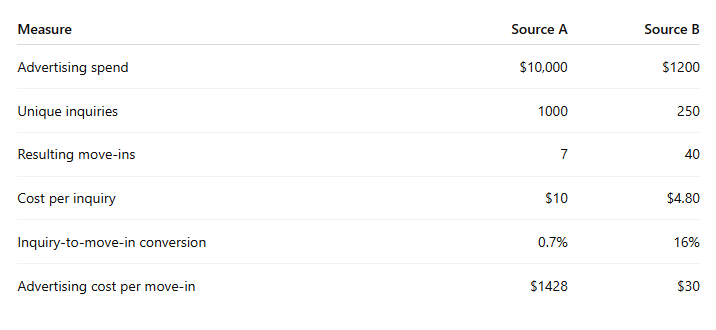
*The statistics shown in the above table are from a real analysis between leads from a premium apartment marketing service (Source A)
and the leads from the company’s in-house managed property websites (Source B.)
Source A produces four times as many inquiries. Source B produces significantly more move-ins at a lower advertising cost per move-in.
A decision based only on lead volume would favor the less productive source in this example.
Calculate both cost per signed lease and cost per move-in when possible. The difference can reveal losses after signing.
Label costs accurately, too. Advertising spend divided by move-ins measures advertising cost per move-in. Use the same cost categories when comparing sources.
In the above example, it was recommended that the company cut ties with the premium apartment marketing service (Source A) and instead allocate more resources in-house (Source B.)
Account for the Work Each Source Creates
Advertising invoices do not capture every cost.
A source that generates large numbers of leads, incorrect inquiries, or requests for unavailable housing may consume substantial staff time. That workload belongs in the evaluation, particularly when leasing teams have limited capacity.
Make the Review Lead to a Decision
A useful lead-source review should end with an action: maintain spending, test an adjustment, correct listing information, improve follow-up, or reduce the investment.
Set expectations around the property’s economics and vacancy needs. A supportable marketing budget depends on factors such as the cost of continued vacancy, expected rental income, available and predicted inventory, and the performance of realistic and reliable lead generation sources.
The central question is whether a source consistently helps fill available apartments at a supportable cost—and whether the records are reliable enough to justify that conclusion.
A busy inbox demonstrates activity. A sound marketing investment requires a clearer connection to results.
